• Searching for Someone to Fix Me – My Psychiatrist (2/4)

    Searching for Someone to Fix Me – My Psychiatrist (2/4)

    I had never met a psychiatrist before, so I had no idea what to expect. But when the secretary told me over the phone that I was lucky to get an appointment with the pill wizard, I started believing in miracles. At least at first. Anxiety pushes you to grab onto anything within reach, because it conditions the brain to find a solution, fast. This wizard was my branch of the moment, and I couldn’t wait to meet him.

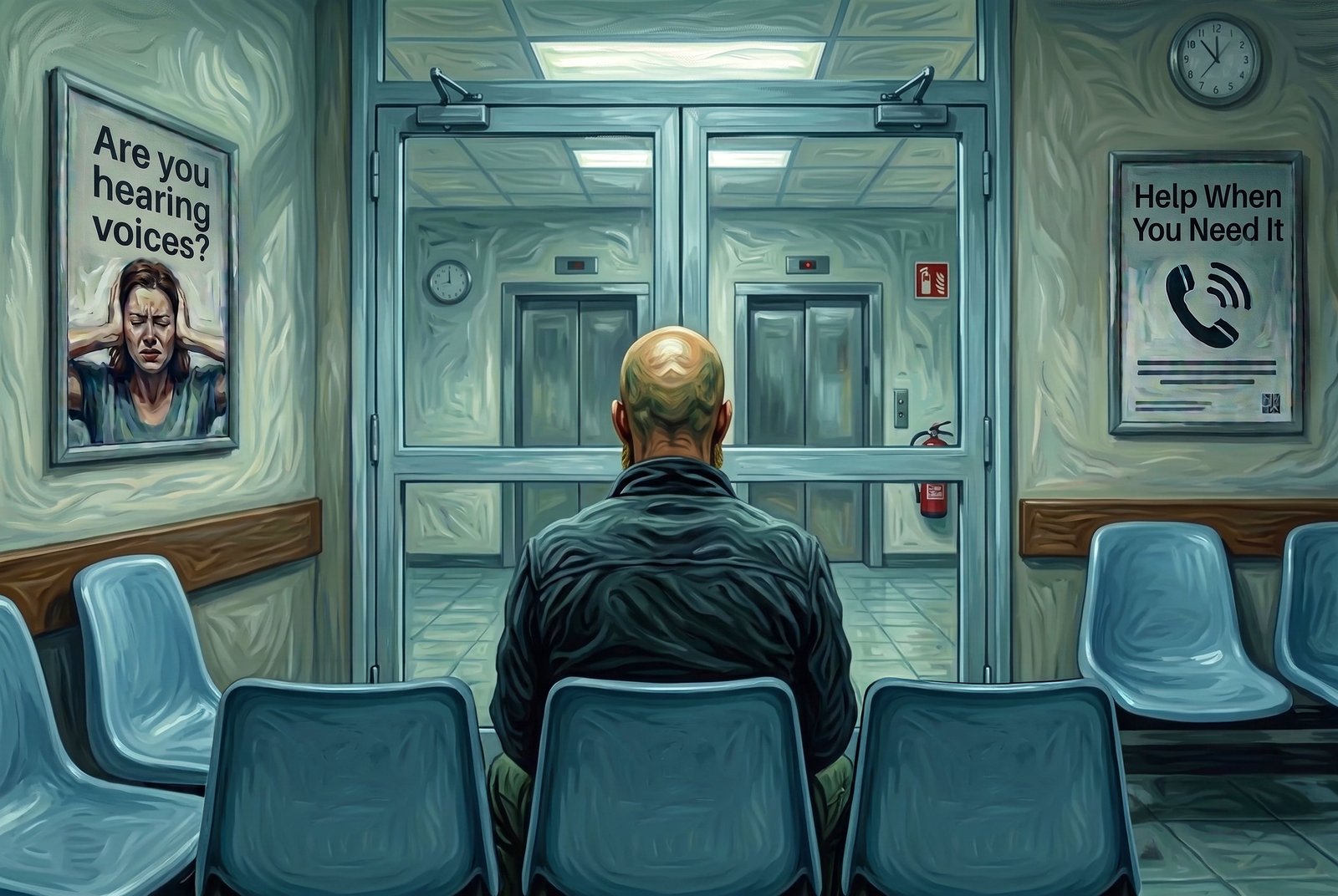
    The day of the appointment, I found myself in the waiting room of a community health center, a publicly funded care facility. Sitting in a medical waiting room chair, I stared at the posters on the walls around me.

    Hearing voices? Call us at …

    Suicide helpline. Anonymous and free.

    I was alone in the waiting room, sitting on a plastic chair, facing the entrance, with the elevators in the background.

    To my left, a long hallway with identical doors that, in all likelihood, opened onto equally identical consultation rooms.

    I waited.

    I watched the elevator doors open regularly. A few staff members came and went. Sometimes patients. Everyone looked at the end of their rope, some appeared to be in crisis, in withdrawal, or completely out of it. Great atmosphere.

    I was among the crazies. Sitting in my chair, I realized I had become a mental patient. I told myself there was still a lot of work to be done, that a psychiatrist’s waiting room shouldn’t be anxiety-inducing or depressing. Everything was designed to make me uncomfortable: the carpet color, the posters on the walls, the plastic plants, the long hallway, and the staff who seemed just as depressed as the patients.

    Finally, a door opened and the wizard called my name.

    He was a normal man, fifties, fairly pleasant, slight smile, direct and open gaze.

    I told him my story, my medication history. He quickly put a label on me: generalized anxiety disorder. Then he prescribed a new antidepressant and an antipsychotic. The fact that I was on benzodiazepines didn’t bother him. He renewed the prescription.

    I didn’t feel rushed. He took his time, asked questions, and I had the sense he genuinely wanted to help. But all his solutions involved swallowing various pills. He suggested we try everything and meet again in three weeks to review and adjust.

    He also gave me his email address, which I found reassuring and rare enough to be worth mentioning. He surely regretted it later, given the number of messages he received from me during crises.

    I left feeling mentally neutral. Neither optimistic nor pessimistic. Neither terrified nor light. Just relieved. Leaving my apartment had become an ordeal. Sitting in waiting rooms was another. I had nothing to lose by trying other medications, but I wasn’t expecting immediate relief.

    Obviously, the new medications resolved nothing. The antipsychotics knocked me out. I slept better but struggled to wake up in the morning and stayed comatose for part of the day. I felt the activation side effects of the new antidepressant for a few days, but nothing serious. I saw no notable change in my mental state.

    I spent the following months meeting with him every three weeks or so. We tried several medications, including pregabalin, an anticonvulsant supposed to have an anxiolytic effect without the dependency issues of benzodiazepines. I took my first dose on a Sunday morning and very quickly found myself in a state of panic, curled up on my couch. I sent him an email, and he replied telling me to stop taking it without even trying to convince me that my state wasn’t related to the medication, but to my perception. Every side effect from a new medication, even a minor one, was always dissected and analyzed, and my hypervigilance only made things worse. I was my own worst enemy.

    Over time, I lost hope. I was trying everything, but nothing seemed to have any real effect, and getting to my appointments had become an ordeal in itself. I couldn’t take public transit, so I went on foot, and the 30-minute walk was agony. Seeing other people happy and carefree had become unbearable. Why were they so effortlessly happy? What was wrong with me?

    My psychiatrist wasn’t a pill wizard. Or maybe my case was too severe, I was beyond saving, and even his superpowers weren’t enough. If he had failed, no one could succeed.

    At an appointment a few days later, seeing my discouraged face, he looked at me with full confidence and said: finally, we know what works for you, it’s Ativan. That’s your molecule.

    I looked at him, deflated. After all those trials, all those capsules, tablets, and pills swallowed, my pill wizard was telling me without shame that I could only be helped by one of the most addictive classes of medication.

    I left discouraged, determined never to see him again, but went back a few weeks later anyway because I had no other choice. He was my only lifeline, the only person who seemed interested in my case, the only one who listened. My search for a therapist was going nowhere, the waitlists during this COVID era were full. He wasn’t perfect, he wasn’t a wizard, but he was all I had.

    Over the following months, my condition slowly began to improve. He had nothing to do with it. I owed this progress to a handful of small things I had put in place in my life that were starting to pay off: seeing people, going out, acting, living, traveling, despite everything.

    My appointments with my psychiatrist naturally spaced out. Our meetings were no longer crisis management sessions. They started looking more and more like informal conversations between friends.

    He showed increasing interest in my love life, my libido, and asked a lot of questions about my day-to-day functioning. I then realized that the commute and the ordeal of the waiting room weren’t worth it anymore. I had other lifelines available. I didn’t need him the way I used to. I decided it was time to end our collaboration.

    At our final appointment, the pill wizard told me that exercise would be a good idea, since it helps reduce anxiety. Six months of follow-up for that…

  • Searching for Someone to Fix Me – My Family Doctor (1/4)

    Searching for Someone to Fix Me – My Family Doctor (1/4)

    My anxiety crisis began in October 2021, but during the summer I had warning signs of the storm that was brewing.

    Several events triggered early alerts. Deaths in the family and the approach of fifty, with the prospect of being seventy in twenty years, began to erode my mental barriers and started me ruminating on death and the end of life.

    I See Dead People

    Disturbing thoughts began to intrude. On the street, I’d tell myself that everyone I passed would be dead in 100 years. I could see their faces wrinkle, age, then putrefy. Young and old alike, they decomposed before me.

    Their faces withered, then melted like hot wax. My delusion didn’t stop with the living. Inanimate objects became troubling too. I’d tell myself they would outlive me. Those small Tupperware containers scattered in the bottom drawer of my kitchen cabinet would still be here for decades, and someone would find them in my apartment when they came to pack my things after I was gone.

    I began to fixate on my body, on my fingernails that I cut, which were literally part of me. Those small pieces of me ended up in the toilet or the trash. The thought unsettled me deeply.

    An Escape to the Rockies Calms My Anxiety

    Fall arrived. These thoughts calmed down, but I realized I had become darker, more stressed. Nothing interested me anymore, I saw nothing positive ahead. My daily life was repetitive.

    I had the sense that I’d lived the most exciting part of my life, and the rest would be a slow decline. I’d finished climbing the steps of the slide, and now it was just the descent to the end.

    Two weeks on vacation with friends to the Canadian Rockies pulled me out of it. Getting away did me good. My mind stayed so occupied that I didn’t have time to dwell on my existential crisis. The question of what to do with the time I had left could wait until I got back.

    Nature, and especially big mountains, have a way of putting things in perspective and a real calming effect on the mind. It’s one of the “lost connections” Johann Hari talks about in his book, as he climbs Mount Tunnel near Banff, in the Canadian Rockies. A place I climbed myself during that same trip.

    Many studies show a reduction in anxiety and depression when individuals are exposed to natural environments, particularly the immense scale of mountain ranges.
    Mount Rundle from Mount Tunnel

    During my stay I began to experience intestinal troubles, my long-time companion. Whenever it tightened, whenever it cramped, I’d imagine a tumor slowly taking root. Thanks, health anxiety.

    Back home, I made an appointment with my family doctor to discuss it.

    The Crypto Gazoline

    On the personal finance side, I was under pressure too. For years I’d been investing in crypto, without much success, but in recent weeks bitcoin had taken off and broken records. The total of my investments had almost hit 100k, and I already saw myself buying an apartment with that down payment.

    The bubble burst. My dreams with it. I didn’t sell in time, and within days the price collapsed. My assets dropped to 10k. I had to resign myself to selling to save what was left, which was less than I’d invested. I became extremely self-critical. An idiot. I should have sold earlier, secured my gains along the way, followed simple rules. I compared myself to others, watching kids on Twitter display their massive gains while I managed to lose everything.

    What an idiot, what a fool, this was my last chance to escape poverty and have real adult things, a car, an apartment of my own” looped in my head.

    Without realizing it, I was moving toward a breaking point. I felt anxiety grow inexorably, and the smallest physical symptoms, added to my intestinal issues, only worsened an anxiety that fed on itself. Without even knowing it.I was pouring gasoline on the fire constantly, without even knowing it.

    Terrified that my stomach pain was cancer, I began to feel like I was losing control. I spent my time searching Google for reasons to hope, but they weren’t enough. I’d question them and was only satisfied when I found signs of an obviously serious illness. I went from reassurance to panic, from panic to reassurance, in a loop.

    With hindsight, and my current experience, I can identify the thoughts that triggered this anxiety and fed it. Some external events were unavoidable, but my attitude, my reflections, my thoughts shaped and pushed my mind in the wrong direction.

    If you want to know about anxiety, read my post “What is Anxiety?

    Time to Get Help for My Anxiety?

    I’ve known my family doctor for ten years. She’s a beautiful, middle-aged woman, energetic and charismatic, always in a good mood, the kind of doctor who tries to cheer you up just by walking into the room. She takes her time, genuinely wants to help, and by now she knows me pretty well. I’ve always had a thing for female doctors. They reassure me and put me at ease. My mother was distant and not very affectionate, so I suppose I’ve always looked to other women, especially doctors, to fill that gap.

    My doctor reassured me, but still made a request for a colonoscopy, since I was approaching fifty and that was the protocol. The explanation was logical, but I still asked her if she had reason to think I had something. I asked her directly if she felt anything during the physical exam.

    To help me while I waited for the appointment, delays being several months out, she prescribed antidepressants. It’s always double-edged when you get prescribed antidepressants. On one hand, you’re relieved. A possible solution. Your problem taken seriously. After all, you go to the doctor for treatment, and if you leave empty-handed, you wonder if this doc knows what he’s doing. But on the other hand, you have confirmation the problem is actually serious. Getting prescribed an antidepressant is crossing into the world of the sick.

    I left with my new status as a mental patient and started taking my doses. Unfortunately, one of the first side effects when you start antidepressants is increased anxiety, which only made things worse.

    I didn’t have the patience or resilience to wait for it to pass, for the medications to eventually work. I went back to see her. We tested other molecules. It was absolutely irrational, in a few weeks I tried five or six different ones without giving enough time to verify their effectiveness.

    Looking back, this dance of medications seems completely deranged. At the same time, she prescribed Ativan, a benzodiazepine, telling me to take it during panic attacks or acute anxiety crises. I was hesitant. I know benzodiazepines. I know their danger. But she tried to reassure me, it was a baby dose. I also got antipsychotics, which at least had the benefit of knocking me out and making me sleep.

    I didn’t touch the benzos at first. I spent the following days trying to hold on while I waited for my colonoscopy appointment in November. I took my medications, I spent hours completely anxious, imagining a tumor growing inside me. I could almost feel it, visualize it. I was completely paralyzed by this thought, unable to shake it. When I was calm, it took just a stomach cramp to fire up the fear machine again. I was hypervigilant. Every body sensation was amplified and connected to a serious diagnosis. Occasionally, I started taking an Ativan here and there, only when I couldn’t take it anymore.

    Colonoscopy Not Guilty

    The appointment finally came and of course everything was fine. The colonoscopy showed nothing. My anxiety disappeared and everything went back to normal. But a week later, I began to feel waves of dread wash over me when I woke up. I had no anchor anymore. My anxiety was no longer focused on one specific issue. But obviously, my brain needed a cause. It decided this time that I was going crazy or that something serious was happening in my brain. The intensity of the fear I felt could only mean a serious cause. I started leafing through the DSM5, the diagnostic manual of mental illnesses, and decided I was bipolar. Then borderline. Then I had major depression.

    I remember going to the clinic reception, pleading my case. Please give me an appointment, it’s an emergency, please can she see me now. I can’t believe now how self-centered I was, convinced I deserved to be seen above everyone else in the waiting room because my mental state was so desperate. I gave the receptionist every detail I could think of to justify being seen urgently, yet at the same time I spoke in a low voice, ashamed, not wanting anyone in the room to hear me. I remember a kind receptionist who checked on me several times while I waited, making sure I was okay and trying to calm me down.

    Mr. Hope

    The clinic visits kept multiplying. At some point, my doctor told me she couldn’t keep being the person I ran to every time I was in crisis. I needed a therapist or a psychiatrist, someone better equipped for this. Beyond prescribing antidepressants or telling me to take benzodiazepines, her options were limited. So she put in a referral for a psychiatrist.

    She contacted me a few days later, told me she’d found a psychiatrist, and gave me his number.

    I made the call. His secretary told me I was lucky to get him. He was known for finding the right treatment fast, “a pill magician” she called him. Hope came back, and I was eager for that first appointment.

    Let’s call him Mr. Hope.

  • My Anxiety Was Loud, Writing Turned Down the Volume

    My Anxiety Was Loud, Writing Turned Down the Volume

    My generalized anxiety started as health anxiety. A small, localized, persistent sensation woke in me the fear of having cancer. At first, to bring the pressure down, I tried the usual techniques: breathing, meditation, distraction. Meditation never worked for me. When you’re being bombarded by intrusive thoughts, looping thoughts, the last thing you want to do is sit comfortably, focus on your breath, and watch your thoughts drift through your mind like leaves on a river or clouds in the sky. My thoughts were not clouds or leaves. They were hyenas attacking from all sides, refusing to let go.

    Sometimes I’d give in to the urge to Google my symptoms, and I’d find something that gave me hope. I’d feel the grip of anxiety loosen. But it was never enough: I had to keep searching to be really sure. Inevitably, I’d find another article with a different take, which was of course the more alarming one, and off we’d go again. When the brain is stuck in alarm mode, all it wants is to feel confirmed. Evidence of immediate danger gets priority. Contradictory evidence doesn’t stand a chance.

    Several books I was reading suggested writing down all my worries, and I started writing what was happening in my head, without much faith in it. Not elegantly. More like garbage bags thrown out.

    The anxiety didn’t disappear, but the looping thoughts settled. They slowed down. There was no more escalation. I stopped combing the internet for treatments for the cancer I didn’t have. I could even consider other options, more rational ones, to explain the physical sensation I had. That was the beginning.

    What I Discovered, and What The Research Confirmed

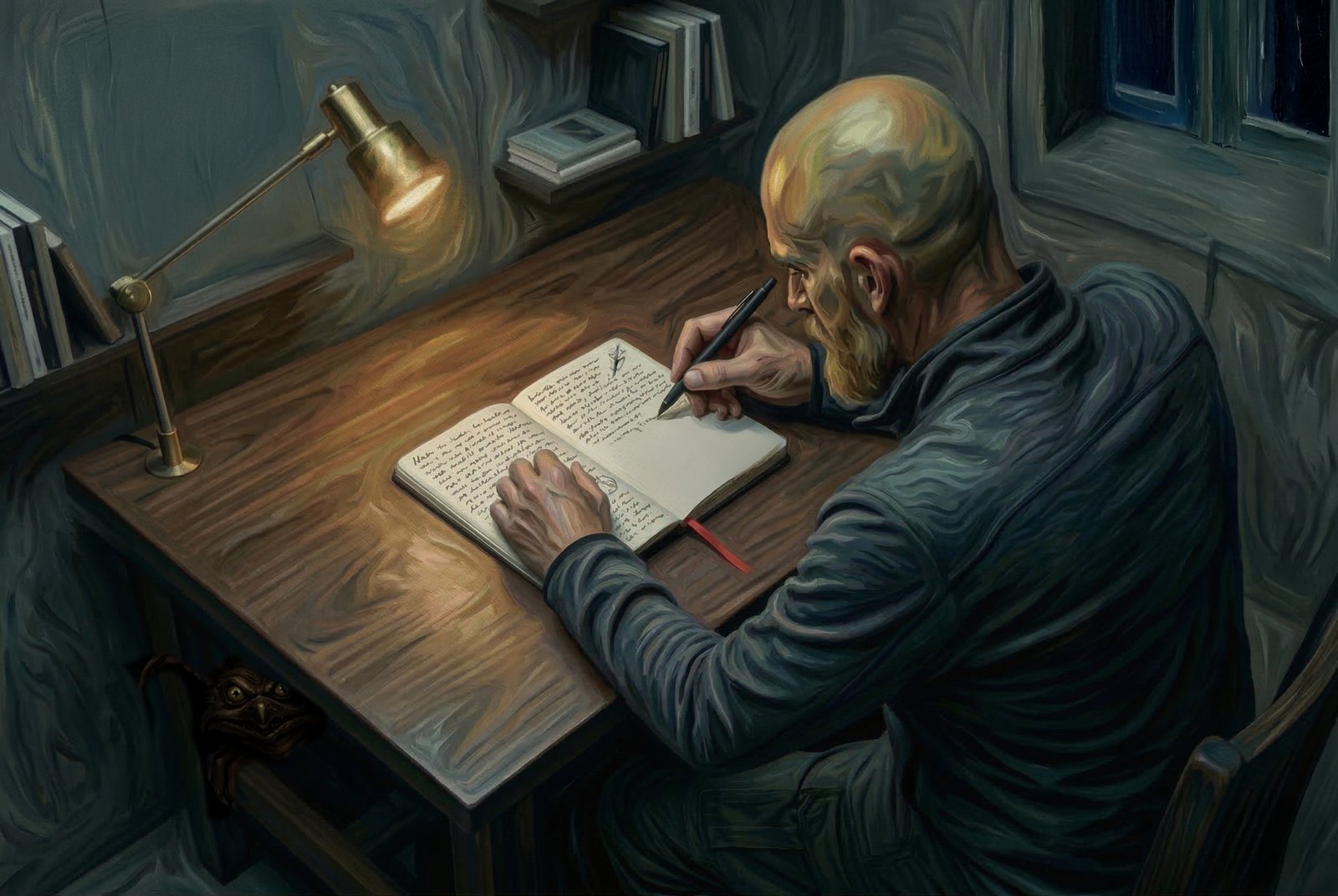
    Since that day, I’ve made a habit of writing in a notebook: my thoughts, my fears, my states of mind, and especially those ruminations that kept me awake late at night.

    Stephen Ilardi, in The Depression Cure, uses an analogy I haven’t stopped thinking about since. He compares it to a shopping list. Before you write a list, your brain keeps rehearsing the items (milk, eggs, bread) because it’s afraid of forgetting them. The moment they’re on paper, the mental repetition stops. You no longer need to hold them in your head.

    Anxiety works exactly the same way. The mind loops through its fears because it needs to find a solution, to finally move on to something else. Writing creates a record. It doesn’t necessarily provide an answer, but it tells the brain: we haven’t found a solution yet, but I’ve described the problem here, it won’t be forgotten, and we can come back to it later. You can go to sleep.

    Simply putting our thoughts down on paper actually makes it easier to stop thinking about them. Once you’ve transferred the information to a sheet of paper, you generally feel less need to keep rehashing it over and over in your mind.

    — Stephen Ilardi, The Depression Cure

    What cognitive therapists figured out sixty years ago

    The link between writing and mental health isn’t new. It sits at the foundation of cognitive therapy itself. Aaron Beck, who more or less invented CBT in the 1960s, built his entire approach around one practice: having patients write down their negative thoughts, then examine them against the evidence. The insight was this: the same thought that felt undeniable inside the head became debatable once it was on paper. A thought you can see is a thought you can question. When it stays inside the mind it’s slippery, mobile, hard to pin down. On paper, it appears for what it is: just a thought.

    Andrea Petersen, a journalist who wrote about her twenty-five years with anxiety in On Edge, describes this from the patient’s side:

    “I wrote down my irrational fears: that I was having a stroke, that I had ALS. Then I wrote down the evidence that these thoughts were likely false … I compiled lists of things that made me happy (reading to my daughter, calling a friend) and picked one to do when the symptoms surged. The CBT worked.”

    — Andrea Petersen, On Edge

    I recognize everything in that. The catastrophic thought that feels undeniable at 4am. The strange deflation that happens when a fear that seemed like a certainty has to defend itself on paper.

    “In cognitive restructuring, the thoughts you think are used to rewire your brain. Our thoughts are not simply a result of neurological and chemical processes in the brain; they are the neurological and chemical processes in the brain.”

    — Pittman & Karle, Rewire Your Anxious Brain

    Changing your thoughts, through writing, through therapy, through practice, is literally changing your brain. Physically, through neuroplasticity.

    Writing to Remember When Anxiety Makes You Forget

    One of the things nobody tells you about anxiety is what it does to your memory of yourself. When you’re deep in it, you forget every time you were okay. You forget every time you coped. The anxious brain edits the past, keeping only the evidence that confirms the fear. It’s not conscious. It’s just what a brain in survival mode does. The amygdala (the alarm system in the basement of the brain) cannot distinguish a real danger from an imaginary one. Its job is to keep you afraid until you’re safe. Until a solution is found. So it holds onto every bad memory and quietly discards the ones where things turned out fine. To counter this bias, it’s important to keep a record of the positive, either by retraining your brain to pay more attention to the good, or by storing that evidence outside your skull.

    Barry McDonagh, in Dare, recommends what he calls a “success diary”: a record of every time you managed anxiety, even a little. Even if it wasn’t a victory, just a survival. You can also write down all the times you had the same worries, and they never materialized.

    “Writing down successes not only helps you remember them, but it solidifies them and makes them more real in your mind. We all tend to forget our achievements, so having a record of them is a powerful tool to have at your disposal anytime you need a boost of reassurance.”

    — Barry McDonagh, Dare

    I tried this. I kept a small notebook beside my bed and every night wrote one line. Something like:

    I left the house. I made it to the end of the street and back. I had a good day, felt little anxiety.

    That counts.At the time it seemed almost stupid. Looking back, it’s one of the most useful things I did.

    It’s not positive thinking. It’s not pretending everything is fine when it isn’t. It’s building an evidence file against the lie anxiety tells you, the lie that you’ve never managed, never coped, never been okay. It’s also a notebook where we store the interventions that worked, the things that pushed the monster back, even for a few hours. Your amygdala will hide this information from you during the next crisis, so it’s important to store it somewhere else. Your own handwriting, on a real page, in a specific moment, is harder to argue with than a vague feeling.

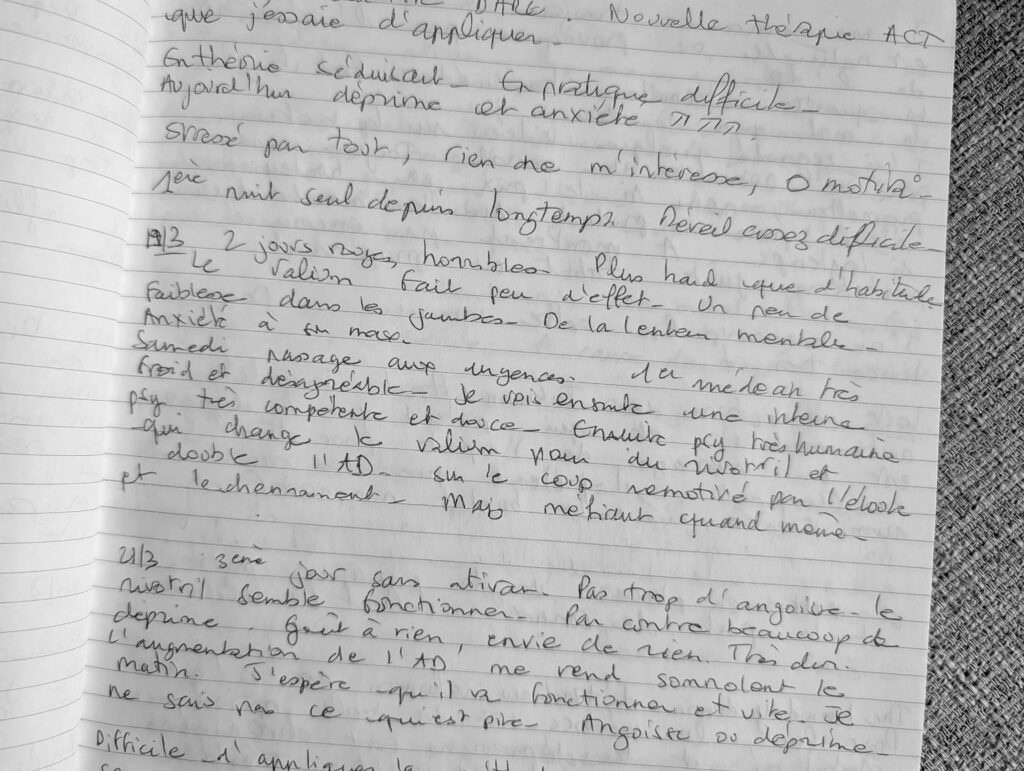
    A close-up of a page in my journal, where the act of writing helps me navigate my anxiety and process everything I feel.

    Writing to Defuse Anxiety

    There’s something else writing does that I only understood later. When you write down what you’re feeling, you have to name it. And naming it changes it.

    Neuroscientists call this “affect labelling.” When you put a word to an emotion (this is anxiety, this is shame, this is the fear of not being enough) activity in the amygdala decreases. The prefrontal cortex, the part of the brain responsible for reason and regulation, activates instead. In a very literal, neurological sense, naming a feeling begins to defuse it.

    Dan Harris, in 10% Happier, describes the same mechanism in meditation. He calls it “noting”: the act of applying a label to what’s happening in your mind. He says it can objectify what’s going on, making it “much less concrete and monolithic.” The journal is the written version of this practice. You write a thought down, and in doing so, strip it of some of its power. It stops being you and becomes something you’re looking at. This is exactly the principle behind ACT (Acceptance and Commitment Therapy), a model for managing anxiety that helped me make real progress.

    I know that sounds almost too simple. It didn’t feel simple in the moment. Writing I am terrified at 4am, and watching that sentence sit there on the page, doesn’t make the terror disappear. But it does something. It creates a thin sliver of distance between you and the thought. And that sliver is where recovery starts.

    “Life is 10 percent what you experience and 90 percent how you respond to it.”

    — Steven Hayes

    Writing to Put your Fears on Hold

    One technique I used on my harder days (what I called my red days) is what therapists call scheduled worry time. And it works specifically because of the notebook. Same principle as before: when a worry arrives during the day, you write it down, but you consciously decide to defer it. You don’t try to solve it. You file it, with a promise to come back later.

    Then, at a time fixed in advance, you set aside twenty or thirty minutes in the evening to go through everything you wrote during the day.

    John Arden, in Rewire Your Brain 2.0, describes a patient who carried a notebook everywhere for exactly this purpose:

    In Lina’s worry hour, she carried around a notebook so that as worries occurred throughout the day she wrote them down. Then between 5 and 6 o’clock each evening, she opened her notebook and devoted the entire hour to reflecting on all the worries. Eventually her worries became boring … The goal is to observe the worries uncritically and label them as merely worrisome thoughts without trying to solve them.

    John B. Arden, Rewire Your Brain 2.0

    Eventually her worries became boring. I love that. That’s the whole point. When you’re anxious, your fears feel urgent, immediate, enormous. They feel that way because the brain can’t tolerate uncertainty and wants to resolve everything immediately. Writing them down and deferring them strips away that urgency. By the time you read the list in the evening, most of it seems more harmless, frankly more ridiculous, than it did at 11am.

    The notebook turns the thought into something you’ve acknowledged but don’t have to deal with right now. A parking lot for fears.

    “Everything seems more important while you’re thinking of it. Later, you’ll realise it’s not.”

    — Derek Sivers, How to Live

    Writing to Sleep

    This parking lot is particularly useful for reclaiming sleep. If anxiety hits you hardest in the evening, putting everything on paper signals to the brain that it doesn’t need to keep churning. We’ll get back to it tomorrow. And often, what was demanding an urgent solution at night has either found one on its own, or has lost its importance by morning.

    If you have troubling thoughts on your mind in the evening, write down your ruminative thoughts. This process often makes it easier to put them aside for the night, since the mind no longer needs to ‘hold’ them.

    — Stephen Ilardi, The Depression Cure

    I used to spend ten minutes before bed just writing out whatever was unresolved. Not to analyze it. Just to put it somewhere. The act of writing was permission to stop thinking. It’s a small thing. But if you’ve spent years lying awake at 4am with a brain that won’t stop, that permission is not a small thing at all. The brain stops rehearsing what it’s already filed. It becomes easier to fall asleep and stay asleep until morning. Sleep quality matters enormously; sleep deprivation is well established as an aggravating factor in mental health.

    Writing to Reconnect your Cortex and Stop Feeling Anxious

    If writing is something you genuinely enjoy, don’t limit yourself to putting your fears and ruminations on paper. Write for the pleasure of it.

    Revisit a good memory. Write a letter to a friend, with no intention of sending it. Invent a story. Start a blog about travel, cooking, fishing. It doesn’t matter. Just write. The simple act of sitting down, taking out a pen and a notebook, is itself a way of taking back control, of reactivating the cortex and putting the amygdala on mute. You’ll probably have to draw on memories, look things up, research a topic, organize what you find. All of this puts you back in action. Your thoughts are no longer hijacked by anxiety but occupied with your writing: Is this plot believable? Is my description precise enough? What was the name of that little Italian town I visited? And the bakery I’d love to recommend on my blog? The possibilities are endless.

    Matt Haig, in Reasons to Stay Alive, described his own version of this. For years he couldn’t write directly about his depression. So he buried it inside a novel:

    Willie Nelson once said that sometimes you have to either write a song or you kick your foot through a window. The third option, I suppose, is that you write a book. … So for a long time I have been writing about it indirectly, in fiction. It was in that novel, more than in any of my others, in which I addressed my own breakdown, but I was really writing about the alienation of depression and how you get over that.

    — Matt Haig, Reasons to Stay Alive

    And his conclusion, after years of that process: “Words, just sometimes, can set you free.

    How to Start When It Feels Too Much

    If you lack the will or energy to build a writing practice from scratch, pick one option below. They’re simple, they take a few minutes, and one is enough to start.

    1. The pre-sleep dump

    Your brain won’t stop at night because it’s afraid of forgetting. Give it permission. Five minutes before bed, write down what’s bothering you most. If, like me, you always think you have a serious illness, write: I’m afraid I have cancer, or I’m afraid I have Alzheimer’s. No more than that. Put the notebook on the bedside table and turn off the light.

    2. The worry notebook

    Most fears feel urgent at 11am and ridiculous by 6pm. During the day, write down a worry the moment it arrives, then close the notebook. Read through everything in a 30-minute window in the evening. You’ll find the supposed urgency has often evaporated.

    3. The success diary

    Anxiety rewrites your history. This pushes back. One line each evening about a good moment in the day. If you can’t find one, write that you survived the anxiety. Notice that despite everything you felt, nothing actually happened to you. You’re still here.

    4. The evidence test

    Anxiety is a terrible lawyer once you put it in writing. Write the thought that’s torturing you at the top of a page, then list the evidence for and against it. Your anxious brain is often very bad at arguing its case on paper. Writing out the argument helps the cortex take back the wheel.

    5. Free writing

    No rules, no goal, no grade. Just write whatever comes to mind. The act of writing is the point. If you lack inspiration, describe an object in the room, or start with: I am grateful to have … in my life.

    Just Start

    Writing won’t cure anxiety like flipping a switch. But it gives the loop somewhere to go. Journaling gives fear a shape, materialized in letters on the page, and almost mechanically, that shape often loses much of its power over you. And when the fear is too close to look at directly, writing lets you step sideways: into someone else’s world through fiction, or into your own curiosity through a blog, a travel note, a recipe, anything that puts your brain to work on something other than itself. Somewhere it can breathe.

    The tools in this article are not a system. You don’t have to do all of them. You don’t have to do them in order. Some will feel useless to you and one will click. That’s enough. Anxiety is loud and convincing and it will tell you none of this is worth trying. That’s the illness talking, not the evidence. The evidence, accumulated over decades of research and over my own years of recovery, points in the same direction: getting thoughts out of your head and onto a page changes something. Not everything. But something. And in recovery, something is where it starts.

    None of this requires talent. It doesn’t require a notebook with a leather cover or a quiet room or the right mood. It requires only that you start, badly, incompletely, with whatever is there. The bar is that low. And sometimes, that’s exactly what makes it work. Give it a try.

  • Going Back to the Forum That Helped Me Get Through

    Going Back to the Forum That Helped Me Get Through

    A few years ago, at the worst point of my anxiety, I found refuge in an online forum dedicated to benzodiazepine withdrawal (benzobuddies). I was not much of a poster, but I read everything. At 2am, unable to sleep, convinced my brain was broken beyond repair, those messages from strangers were sometimes the only thing that kept me going.

    I never went back after I recovered. The forum was too tied to that period, and I needed distance.

    But recently I felt it was time. Not to revisit the pain, but to give something back. So I wrote a long message to the people still there, still in the thick of it.

    I’m sharing it here too, because I know some of you are living through something similar, with or without benzos. The mechanics of anxiety are the same. And the way out is the same.

    Here is what I wrote.

    Hi everyone,

    A few years ago, I went through the worst period of my life. Several months of intense anxiety, sometimes pure terror. I came here often to read posts, and reached out a few times asking for help (see my first post here)

    I have been benzo-free for 3 years. I have been anxiety-free for over 2 years.

    I stayed away for a long time, because this forum, as helpful as it is, is associated for me with painful memories. But today, with hindsight, I wanted to leave a message of hope for those who are still suffering, especially those going through withdrawal.

    What I came to understand

    When I was in crisis, I thought I would never get out. I thought my brain was permanently damaged, and that my only hope was for some new treatment to come along one day.

    What I’ve learned since: when you’re anxious, you’re no longer yourself. You no longer think normally. Your entire personality is temporarily rewired to stay in a permanent state of alert, a survival mode that distorts everything.

    There is no miracle solution. No quick fix. You don’t become anxious or depressed overnight, and the road back is just as long. But it exists.

    What helped me

    1. Stopping benzos

    I don’t hold benzos responsible for my generalized anxiety, but they acted as an amplifier, and also as a roadblock. Withdrawal got in the way of my recovery. Tapering off benzos helped reduce the baseline anxiety level, lengthen the windows and reduce the waves, until waves eventually stopped. But that alone wasn’t enough.

    2. Therapy, with the right therapist

    My therapist was essential. Being able to talk every week about how I was feeling, having someone help me reframe what was happening, that’s invaluable.

    One thing to keep in mind: it’s not enough to have a therapist, you need the right one. The right match is 50% of the battle. Don’t hesitate to try several.

    3. Understanding how the brain works

    This is probably what changed things the most for me.

    I learned that my thoughts are not my personality. They are not truths. They are mental processes, products of my brain. When the amygdala (the primitive brain, responsible for the alarm system) is in charge, thoughts become messages of danger and fear. That’s its job: to protect us. The problem is that it doesn’t distinguish between real danger and imaginary danger.

    When the cortex, the rational brain, regains control, thoughts become more useful, more balanced.

    So I learned to observe my thoughts, to see them from the outside, like a witness. To realize that my brain thought it was protecting me by triggering the maximum alarm, but was destroying me in the process.

    Two approaches helped me a great deal with this:

    • The DARE method and ACT (Acceptance and Commitment Therapy), to stop fusing with my anxious thoughts, and let them pass without feeding them.
    • IFS (Internal Family Systems), to understand that our psyche is made up of several parts: an adult part (the rational cortex), a protective part (the amygdala), and often a child part, sometimes wounded, that reacts to present-day triggers. This model helped me stop seeing myself as a failure or a weakling because I was experiencing extreme anxiety when my life was “going fine.” During crises, I recognized that it was my child part showing up, and I tried to reassure it rather than fight it. It’s another way of looking at Acceptance (from ACT), and one that I found more intuitive. Many of these approaches overlap more than they differ.

    4. Taking action anyway

    Anxiety, in its survival logic, pushes us to stop doing things. Stay home. In bed. On the couch. Stay safe.

    I understood that you have to do exactly the opposite: force yourself to do what anxiety is preventing you from doing, and stop doing what anxiety is pushing you to do.

    I started going out again, exercising, picking up activities, even when it was torture, even when I had no energy. And I stopped giving in to the urge to stay in bed, skip meals, isolate myself.

    It’s hard. But it works. Rumination and negative thoughts leave traces in the brain, reinforcing neural pathways that make us see life negatively. Conversely, taking action and paying attention to good moments, even small ones, gradually rewires the brain.

    To close

    I still have anxious thoughts. But I’m able to see them for what they are, and not spiral into rumination. Anxiety feeds on itself. It’s a vicious circle that is very hard to stop. When you learn to observe your thoughts without merging with them, you can catch the loop early, before it takes over.

    Things will not get better on their own. The anxious brain operates on a pattern that has built up over time and it needs to be retrained. That takes long, difficult work: changing automatic reactions, learning to step back and analyze what’s happening in your head, gradually shifting your thought patterns.

    Medication, antidepressants in particular, can be useful to take the pressure down and create the space needed to do this work. But they don’t cure, in the sense that they don’t fix the thought patterns that led to the anxiety in the first place. They are a crutch, sometimes a necessary one, but the retraining work still has to be done. Alone, through books, or with a therapist.

    I know that what I’m writing might be hard to hear for some. If I had read this when I was in crisis, I wouldn’t have believed it and would have thought: he wasn’t as sick as me. I’m beyond help.

    But that’s exactly what your anxious brain wants you to think. It wants to keep you in that state, because for it, that state feels safe.

    What will help you is precisely what frightens you, and right now, your brain wants nothing to do with it. You have to start living again, even if it’s hard, counterintuitive, and scary. That’s the only way to show your brain that everything is okay, and that it can turn off the alarm. There will be setbacks, discouragement, but little by little, things will get better.

    If you’re still in the thick of it: hold on. This is not permanent. Your brain is not broken. It’s exhausted and in overdrive. With time, support, and the right tools, it can recalibrate.

    Wishing you all a full recovery ❤️

    If you are reading this from a relatively calm place, maybe this gave you some language for what you went through, or are still going through.

    If you are reading this in the middle of a crisis, I want you to know that I wrote every word of it from memory. I was there. It was real. And it ended. That is the only thing I can promise you: this is not permanent. Your brain can heal. The way out exists, even when you cannot see it yet.

  • I Stopped Fighting My Anxiety. Here’s What Happened

    I Stopped Fighting My Anxiety. Here’s What Happened

    I’ve read a lot of books about anxiety. To pass the time during the worst of it. To look for answers. To feel less alone by reading other people’s stories.

    Some of them, like Barry McDonagh’s DARE, gave me tools that actually helped push the beast back and slowly loosen its grip.

    DARE is an acronym: Defuse, Allow, Run Toward, Engage. It’s also a verb. To challenge. To brave. To confront. That’s not a coincidence.

    The book is aimed mostly at people who have panic attacks. That wasn’t really my situation. My problem was chronic anxiety, that background tension that never quite lets go, that settles in and slowly grinds you down. I tried the method anyway. Tested it. Kept what helped.

    Anxiety Feeds on Itself

    McDonagh opens with a simple idea that changes everything: it’s not anxiety that destroys you. It’s your fear of anxiety. It’s the attitude you bring to those excessive, destabilizing emotions.

    He calls it the anxiety loop. You feel a sensation, heart racing, dizziness, an intrusive thought, and you react with fear. That fear produces more adrenaline. More adrenaline produces more sensations. More sensations produce more fear. And so on, indefinitely.

    In my case, I didn’t understand where my anxiety was coming from. I was afraid I had a serious illness, afraid I was losing my mind, which only amplified everything. And during the rare moments of relief, usually in the evenings, I’d lie down dreading the next morning. Convinced the anxiety would be there when I woke up. Which, of course, it always was.

    The loop doesn’t spin because you’re fragile or broken. It spins because you’re responding the wrong way to something that, in itself, isn’t dangerous. It’s a fire alarm going off in an empty building. The problem isn’t the alarm. It’s that you keep searching for smoke when there isn’t any.

    D — Defuse: The Art of the Mental Shrug

    The first response when anxiety shows up.

    When an anxious thought arrives, the instinct is to take it seriously. To believe it. To find an answer. To reassure yourself. To solve the problem.

    McDonagh says: don’t do any of that. Just respond with something close to boredom.

    “So what. Whatever.”

    Not a logical argument. Not an attempt to convince yourself everything is fine. Just a mental shrug. The point is to strip the thought of its urgency before it snowballs.

    This was the most immediately useful step for me. Feeling anxious without interruption is exhausting. At some point, that exhaustion becomes a resource. I’d find myself so tired of my own anxious thoughts that I no longer had the energy to take them seriously. That’s where the so what made sense, not as a technique applied with discipline, but as genuine exasperation. I’d already been doing it without realizing. Reading the book, I started doing it on purpose, from the moment I woke up.

    You again. So what.

    Something would release. Not completely, not permanently, but the pressure would drop a notch. I’d found a small lever I could pull to quiet the noise.

    A — Allow: Inviting the Enemy In

    The most counterintuitive step in the book. And probably the most important.

    Everything in you wants to resist anxiety. Run from it. Suppress it. Force it to leave. McDonagh argues that’s exactly what keeps it alive. What you resist persists. What you flee pursues you with even more determination.

    The move is to do the opposite: invite anxiety to stay.

    “I accept you. Sit down. I don’t like you, but you can stay as long as you need.”

    This isn’t resignation. It’s a deliberate decision to stop creating friction against a nervous energy that, left alone, will naturally dissipate. Anxiety is a wave. It rises, peaks, and falls. Resistance holds the wave at its crest. Acceptance lets it complete its arc.

    The essential distinction: you’re not trying to make anxiety leave. You’re trying to stop being afraid that it’s there. Those are not the same thing.

    For me, this was the natural extension of defusing. Once you stop fighting, you can start welcoming. I eventually stopped resisting. I came to accept anxiety as a traveling companion, something sitting on my shoulder, present, not always comfortable, but there.

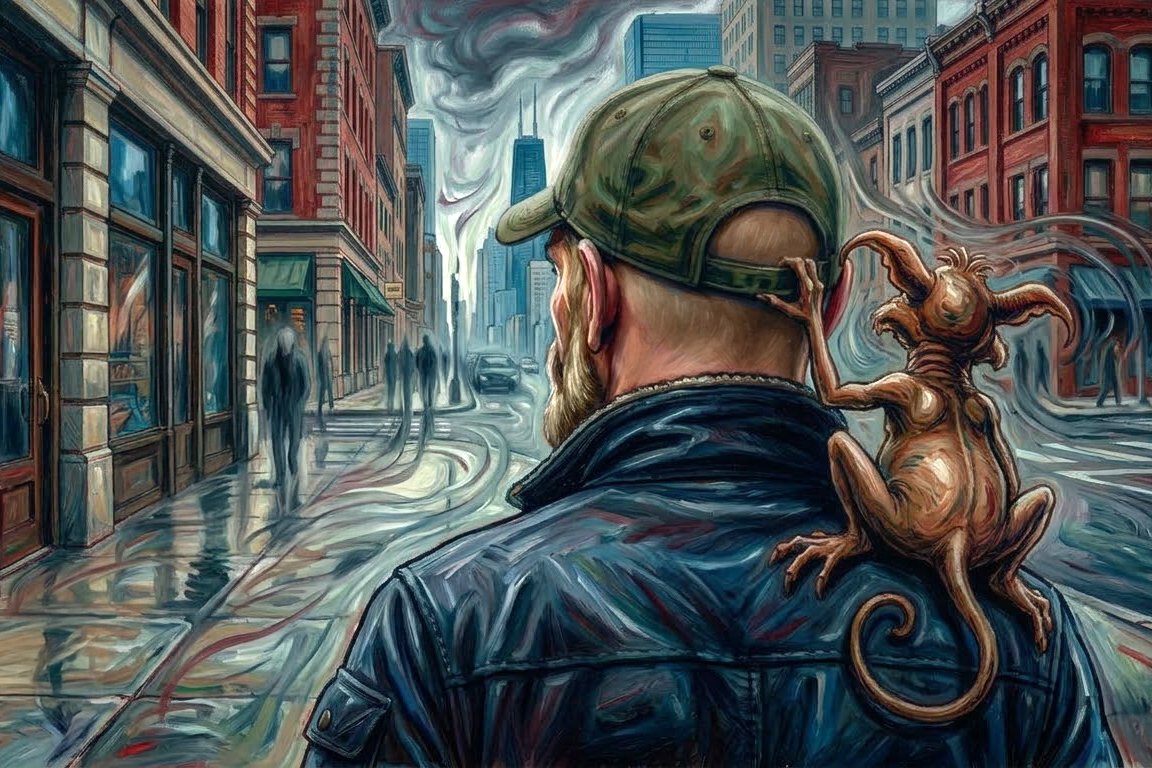
    The book talks about sock puppets, ridiculous little figures whispering scary things in your ear. I had my own version. I’d picture the small creature from Star Wars, Salacious B. Crumb, Jabba the Hutt’s sidekick, speaking with a ridiculous cartoon voice. This grotesque little thing murmuring catastrophes in a voice that was impossible to take seriously.

    It’s not a sophisticated technique. But it worked. Because anxiety, seen that way, immediately loses its gravity. It’s no longer an existential threat. It’s a comic character doing its best to convince you the world is ending, in a voice you’d struggle to believe. Just that shift in perception made it less terrifying. The little gremlin on my shoulder became another lever I could pull.

    A Tool I Added: Watching Your Thoughts Instead of Drowning in Them

    DARE gave me a structure. But I grafted something onto it that made it more effective for me, a principle from ACT, Acceptance and Commitment Therapy.

    One of its core tools is called cognitive defusion. The idea is simple. The language we use to describe our inner states isn’t neutral. It creates reality.

    When you say “I am anxious”, you fuse your identity with the state. You become the anxiety. There’s no longer any distance between you and it.

    When you say “I’m having the thought that I’m anxious”, something shifts. You position yourself as an observer of the state rather than a hostage to it. The anxiety is still there, but you’re no longer inside it. You’re watching it.

    This is what DARE practices through the Allow step, without always naming it that way. But having the precise formulation helps. A few concrete examples:

    Instead of “I’m afraid to go outside”, think “I’m having the thought that going outside is dangerous”

    Instead of “I’m going to lose control”, think “I’m having the thought that I’m going to lose control”

    Instead of “I’m worthless”, think “I’m having that old thought again, the one that says I’m worthless”

    In each case, the thought is no longer a fact, a truth. It’s just a mental process. An electrical signal traveling through the brain.

    This isn’t semantics. Simply naming an emotion from a distance activates the prefrontal cortex, the rational part of the brain, and dials down the amygdala, the alarm center. You’re not telling yourself a story to feel better. You’re changing the circuit that processes the threat.

    R — Run Toward: Charging the Fear

    If anxiety still feels like a threat after the first two steps, McDonagh proposes something radical: move even further toward it.

    One of the book’s central points is that fear and excitement aren’t opposing emotions. They’re two versions of the same emotion. The body produces exactly the same responses in both cases, racing heart, quickened breathing, muscle tension, heightened alertness. The only difference is the interpretation you place on those sensations. A story of threat, or a story of anticipation.

    For panic attacks specifically, the move is more forceful: demand more.

    “Is that all you’ve got? Give me the worst panic attack you can. I’m done being afraid of you.”

    It sounds irrational. That’s exactly why it works. If you were facing a real threat, you wouldn’t ask for more of it. The emotional brain receives that incoherent signal and cuts the alarm.

    In my case, this step felt unworkable for a long time. My anxiety was so constant, so pervasive, that asking for more seemed absurd. It was already too much.

    But I witnessed something revealing, without having looked for it.

    At the height of my anxiety, I joined a dragon boat club. On my very first time on the water, before the coach gave the signal to paddle, I felt all the familiar symptoms rise in me. Heart accelerating. Body tightening. Nerves humming.

    But this time, I didn’t feel bad. I felt excited. Genuinely, positively excited. I wanted the coach to tell us to start paddling, to cut through the water on the canal. Those sensations I had feared for so long were exactly the same ones I was feeling in that moment, they just had a different name.

    It’s one thing to read that anxiety and excitement are biologically identical. It’s another to feel it in your body, a paddle in your hands.

    E — Engage: Returning to the World

    The final step is short but essential. After defusing, allowing, and running toward, the anxious mind will naturally try to pull you back into the loop. The way to prevent it: give your mind something concrete to do.

    Not distract yourself. Engage. The difference matters. Distraction is fleeing anxiety by thinking about something else. Engagement is returning to life, moving forward alongside anxiety rather than waiting for it to disappear before you act.

    This is where everything really shifted for me. Not engagement as an anti-anxiety technique. Engagement as a return to living.

    In my case, I decided to push myself and go outside my comfort zone. As I said before, I joined a dragon boat club. I didn’t want to, it made me nervous at first, and it was mostly a way to force myself outside. It gave me three things at once: physical activity, new people to mingle with, and new skills to learn. A mind busy mastering something new doesn’t have as much room to ruminate.

    I bought an indoor bike trainer for the days when going outside felt impossible. I bought an electronic keyboard to learn piano at home with an app, I still can’t really play, but the time spent learning calmed me. There’s something about the concentration that a new instrument demands that leaves little room for anxiety. I also took sign language classes, though that one worked less well. Everything was taught in silence, I struggled to follow along, my brain refused to decode the signs or make them, and I ended up judging my own inability.

    I joined an urban gardening association, community planting in the neighborhood’s back alleys. This kind of activity is recognized as a form of social therapy. Coming together around a shared task, receiving gratitude from residents who appreciate seeing their alley transformed, it’s simple, concrete, and good for the spirit in a way that office-based therapy doesn’t easily replicate.

    I forced myself to go work in cafés. Not to socialize actively, just to be around people, to observe the world moving around me, to escape isolation without the pressure of performing socially.

    None of this happened overnight. It was an accumulation of small repeated gestures that slowly put distance between me and the anxiety. Not by fighting it. By reclaiming my life in spite of it.

    What Reached Me, and What Didn’t

    I tried cognitive behavioral therapy (CBT). It never worked for me. The idea of challenging my thoughts, replacing them with more rational ones, never landed. It might quiet things for five minutes, but the brain finds a workaround and eventually sounds the alarm from a new angle.

    What spoke to me was something different. Becoming an observer rather than a victim. Moving toward action rather than waiting for anxiety to pass. Accepting without resisting. And above all, actually understanding what happens in the brain when anxiety strikes. Understanding that it’s a misfiring protection mechanism, not a sign that something is fundamentally broken. That understanding changed my relationship with anxiety more than any technique.

    In general terms, relieving anxiety means doing everything it tells you not to do, and not doing what it pushes you toward. It’s a form of exposure, the same principle used to treat panic disorders, but applied more broadly.

    When the brain perceives a threat, real or imagined, its goal is to put you on high alert and authorize only the thoughts and actions aimed at keeping you safe. It shuts down the pathways toward pleasure, appetite, joy, and calm, because those are distractions from survival. It wants to keep you vigilant. Or it pushes you to hide, to go still, to stop moving altogether.

    To deactivate that stance, you have to do precisely what the brain is refusing you: go outside, meet people, move your body, eat, do all the things you used to love, even when it feels like a form of torture. And if the only option that seems available is lying in bed, collapsing on the couch with noise-canceling headphones, not moving, that’s exactly what you shouldn’t do.


    The Healing Console

    DARE isn’t a miracle method. McDonagh is honest about that. Recovery isn’t linear. There will be setbacks. There will be days when the four steps feel impossible to apply. There will be mornings when the anxiety is back as if nothing had changed.

    What matters is what you do with those moments. Whether you treat them as proof of failure, or as a normal part of the process.

    The way I’ve come to see recovery is this: at some point, through therapy, books, forums, conversations with people who’ve been through it, you discover that you’re standing in front of a healing console, covered in levers and buttons. Each one represents something that can calm the nervous system, reactivate the cortex, loosen the grip a little. Walking in nature. Cardio. Quality sleep. Cutting alcohol. Working with a therapist. Exploring rTMS, CBT, ACT, DARE. Doing puzzles. Learning a new skill. Traveling. Keeping a journal. Meditating. The list is long.

    Your anxious brain doesn’t want you anywhere near that console. It sees every lever as a distraction, a waste of precious energy. In survival mode, there is only one directive: conserve energy for fighting, fleeing, hiding.

    Joy, pleasure, calm, connection, those are luxuries it cannot afford right now. So it steers you away from the very things that would help and makes you afraid of that console. Everything seems scary, exhausting and pointless.

    None of these levers works fast. Retraining the brain takes months. They don’t need to be pulled in order, and none of them is mandatory. If one doesn’t work, you move to another. No guilt. No lost ground. Use one lever and if you feel a little better, do it again and try another one. And another one. Gradually, you feel more confortable, the grip loosens, and the console seems much less frightening. Pulling the levers gets easier and easier. Some levers eventually become automatic, you no longer pull them consciously, they simply become part of how you live.

    That’s the process. Not a sudden cure. A quiet accumulation of small gestures that, one day, make a difference you never saw coming.

    My first sign was a laugh. I was watching a show, and something made me laugh, really laugh. I hadn’t laughed in months. The next day was agony again. But something had shifted. The door had opened, just a crack. That was enough.

    McDonagh closes the book with a simple line:

    “Life is waiting for you — go out and join it. I dare you to. You’ve been away too long.”

  • Who I Am, and Who I Am Not

    Who I Am, and Who I Am Not

    My name is Marc. I am in my fifties, born French, became Canadian, and for most of my life I thought I knew who I was.

    I thought I was shy. Cold. Individualistic. Not social at all. I was never an employee, I always ran my own business or worked for myself. I always had difficulty connecting with others and making friends. I always preferred individual sports, running mostly, over team sports. I always believed that the choices I made in my life, particularly professionally, were the result of my own decisions, my personality, my nature. What a mistake.

    It took me decades, and a complete breakdown, to understand that almost none of it was a choice. It was anxiety, pulling the strings behind the scenes, from the very beginning.

    “Until you make the unconscious conscious, it will direct your life and you will call it fate.”

    — Carl Jung

    Where it all started

    I grew up in a deeply dysfunctional family. My parents argued constantly. Infidelity was common. Consumed by their troubled relationship, they were emotionally absent, incapable of showing affection. My father had no interest in me because I did not share his world: hunting, soccer, and a certain idea of the role of men and women in society. When he finally understood that I would never be the ideal son, he shifted his attention to my sister and ignored me completely. My mother was depressive and suicidal. She made attempts. When I was eighteen, she was diagnosed with leukemia. A few months later, as the illness reached its terminal stage, she chose to leave on her own terms.

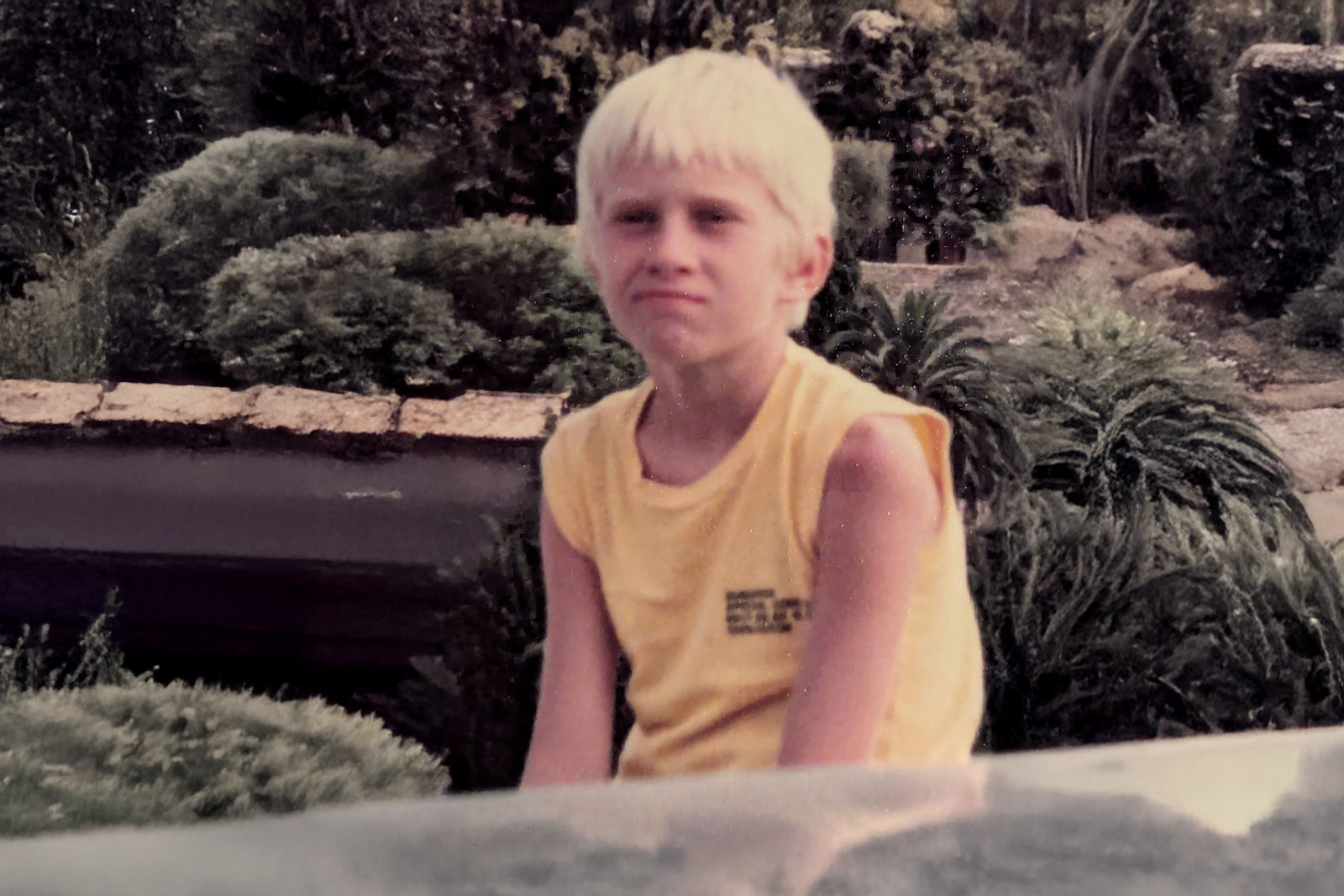
    At home I was invisible at best, a disappointment at worst. But school was no refuge either. I had white hair, I was very pale, very thin. The other kids called me the albino. I was bullied. I was never invited to birthday parties. I did not fit in anywhere, but curiously I did not suffer from it. I let myself be absorbed by studies, science, aquariums, biology, cosmology, all kinds of fields that captivated my mind and kept me occupied.

    I felt like an alien. The others were different, and functioned in ways that were a complete mystery to me. Social and interpersonal rules seemed incomprehensible.

    I did not know it yet, but my nervous system was learning lessons it would carry for the rest of its life. That the world was dangerous. That people leave or push you away. That something would always go wrong. That I was deficient. That I was a monster, incapable of feeling affection or empathy.

    Not long after losing my mother, I developed health anxiety. At thirty-five, a tumour the size of an orange was found in my abdomen. The specialist was certain: given the size, it could only be cancer. He gave me two years at most. It was a rare cancer, with no treatment other than surgery. I underwent a major operation, which allowed the tumour to be analysed and found to be benign. But the fear of illness that already lived in me found new territory to occupy, and it never really left. I remained afraid of medical tests and doctors, to the point of fearing that a dental X-ray might reveal a tumour in my mouth.

    The perfect storm

    In 2021, everything fell apart. A serious health scare triggered a surge of anxiety of an intensity I had never known. Two people close to me died by suicide in a short period of time. Approaching fifty, and realising I had twenty years left before turning seventy, hit me hard. And for long months, my nervous system was put to the test when I decided to invest in cryptocurrency, only to lose a great deal. The background noise that was my anxiety became a roar.

    By 2022, I was no longer functioning. What I was experiencing was no longer anxiety in the ordinary sense. It was constant, relentless terror. The feeling, for several hours a day, of being on a plane that is going down. Over time, depression followed, logically. Then anhedonia set in, the inability to feel anything positive. My energy levels dropped sharply. I could not even sit in a chair in front of my computer.

    “Not until we are lost do we begin to find ourselves.”

    — Henry David Thoreau

    What I understood

    Working through this with a therapist did something I did not expect. It did not just help me manage the crisis. It helped me see my entire life differently.

    The shyness was social anxiety. The coldness was detachment learned in a home where closeness had never been safe. The individualism was self-protection. The career choices, the sports, the small circle of relationships: anxiety had been quietly making decisions for me for forty years, and I had called it personality.

    I had always known something was off. I thought it was my genes, some fundamental flaw in how I was built. What I discovered is that my behaviour was the product of my thinking system, shaped in a chaotic and lonely childhood, and stripped of the foundations that parents are responsible for providing: security, affection, communication, attention. That system was refined by a succession of traumas: emotional distance, humiliation, bullying, rejection. But that system was not who I was. It was simply what I had learned. And what is learned can be unlearned.

    My crisis lasted years, with ups and downs. Some days were normal, others were spent at the bottom of a bed or on a sofa. I called the good days blue days, and the others red days. There were waves of terror, and windows of respite. Little by little I understood things, learned techniques, educated myself, and came back into the world. The battle is not won. I have not had a crisis in two years, but I can feel that on certain mornings, familiar sensations resurface. I have learnt the tools to defuse them, but I know I am not safe from a real relapse.

    “Between stimulus and response there is a space. In that space is our power to choose our response.”

    — Viktor Frankl

    Who I am not

    I am not a therapist. I am not a psychiatrist, a doctor, or a researcher. I have no qualifications in mental health, other than having lived it from the inside, studied it obsessively, and come out the other side.

    Everything I share here comes from my own experience and my personal reading. It is not medical advice. It is not a substitute for professional support. If you are struggling, please see a therapist or a doctor. This newsletter is a complement to that work, not a replacement for it.

    I am still in the noise. My brain is still hyperactive, still quick to sound the alarm, still occasionally convinced that something is really wrong when it is not. I have just learned, slowly and imperfectly, to stop letting it drive.

    Not a therapist. Not a doctor. Just someone who went through hell and came back with notes.

    Welcome.

  • What is Anxiety ?

    What is Anxiety ?

    Understanding what you are dealing with.

    Let me start with something that changed everything for me.

    Anxiety is not a character flaw. It is not weakness. It is not you failing at life. It is a biological system doing exactly what it was designed to do, just in the wrong context, at the wrong time, for the wrong reasons.

    Once I understood that, everything shifted. Not immediately. Not completely. But the shame started to lift. And shame, it turns out, was making everything worse.

    So let’s talk about what’s actually happening inside you when anxiety strikes.

    “Worry often gives a small thing a big shadow.”

    — Swedish proverb

    The Alarm System

    You have a smoke detector in your brain. It is just very bad at its job.

    Deep inside your brain sits a small, almond-shaped structure called the amygdala. Its job is simple and ancient: detect danger, trigger a response, keep you alive.

    When the amygdala senses a threat, real or perceived, it fires an alarm. Instantly, automatically, without asking your permission. It sends a signal to your body: danger is here, prepare to fight or run.

    This is the fight-or-flight response. Your heart rate accelerates to pump more blood to your muscles. Your breathing quickens to take in more oxygen. Your digestion slows, because the body does not care about lunch when a predator is nearby. Stress hormones flood your system. Your senses sharpen. Your body becomes a machine optimised for one thing: survival.

    This system is extraordinary. It has kept humans alive for hundreds of thousands of years. When a lion appears, you do not want to stop and think. You want your body to react before your conscious mind even registers what is happening.

    The problem is that the amygdala is primitive. Ancient. It evolved in a world where threats were physical, immediate, and usually obvious. A predator. A rival. A fall from a height. It is extraordinarily good at responding to those kinds of dangers.

    But it has no idea what a work email is.

    What Anxiety Does To You

    When the alarm fires, everything non-essential shuts down.

    When the alarm fires, your brain has one priority: get you through the next few minutes alive. Everything else is switched off, turned down, or redirected. And this is where it gets fascinating, because a lot of seemingly mysterious anxiety symptoms suddenly make sense.

    Your appetite disappears.

    You do not need to be hungry when you are running from a lion. Digestion is metabolically expensive and completely irrelevant in a crisis. So the body shuts it down. This is why anxious people often cannot eat, lose weight without trying, or feel nauseous at the thought of food. Your body is not malfunctioning. It is following the emergency protocol.

    You lose the ability to feel pleasure.

    Joy, excitement, contentment: these emotions serve no survival purpose when danger is present. The brain deprioritises them completely. Why would you stop to appreciate a sunset when a predator is chasing you? This is anhedonia, the inability to feel positive emotions, and it is one of the cruelest symptoms of chronic anxiety. It is not depression in the conventional sense. It is your brain ruthlessly allocating all available resources to survival, leaving nothing for happiness.

    Your sleep breaks down.

    The body cannot fully rest when it believes danger is near. Light sleep, broken sleep, waking at 3am with a racing heart: these are features, not bugs. A sleeping animal is a vulnerable animal. Your nervous system is keeping one eye open, just in case.

    Your muscles tense.

    Ready to run or fight at a moment’s notice. This is why chronic anxiety often comes with jaw clenching, neck pain, headaches, and a body that feels permanently braced for impact.

    Your thinking narrows and your rational brain goes offline.

    In a genuine emergency, you do not need creativity or nuance. You need fast, binary thinking: safe or dangerous, run or fight. So the brain does something radical. It partially shuts down the prefrontal cortex, the part of your brain responsible for rational thought, perspective, complex decision-making, and emotional regulation. The amygdala takes over completely. This is sometimes called an amygdala hijack: your primitive alarm system literally overrides your higher brain. You become less able to think clearly, less able to see solutions, less able to put things in perspective. It is not that you are not intelligent enough to handle the situation. It is that your brain has physically reassigned control to a system that is only interested in one question: am I going to survive the next five minutes? Everything else, logic, nuance, reason, goes offline. You are not confused because you are weak. Your cortex has just been temporarily taken hostage.

    Your world shrinks.

    Anxiety makes everything feel like a threat. Social situations, new experiences, uncertainty of any kind: the alarm fires at all of it. Avoidance feels like relief in the short term. But avoidance teaches the brain that your fears were justified, and the world gets smaller.

    All of this makes perfect sense if you are being chased by a predator. It is catastrophic if it runs for months or years in response to modern life.

    A Brain Not Built For This Worl

    Your brain cannot tell the difference between a lion and your inbox.

    This is the fundamental mismatch at the heart of modern anxiety.

    Your amygdala does not distinguish between a physical threat and a psychological one. Between real danger and imagined danger. Between a lion chasing you and a difficult conversation you are dreading. Between a predator and a financial worry that keeps you up at night.

    To the amygdala, a threat is a threat. And modern life is full of triggers it was never built to process: deadlines, social judgment, uncertainty, loneliness, the relentless noise of the news, the constant low-level pressure of simply existing in a complex world.

    So it fires. Again and again. Sometimes all day long.

    Your heart races during a meeting. Your chest tightens reading a message. You wake at 3am convinced something is terribly wrong, your body flooded with adrenaline, primed for a danger that does not exist.

    This is not madness. This is a very old system running in a very new world.

    The Monkey Mind

    Your thoughts are not you.

    There is a concept in Buddhist tradition called the monkey mind. The image is precise: a monkey swinging from branch to branch, never still, never silent, chattering endlessly. That is what an anxious mind feels like from the inside.

    The monkey is your thoughts. And here is something crucial that took me a long time to truly understand: your thoughts are not you. They are not facts. They are electrochemical events, patterns your brain generates based on habit, fear, past experience, and a nervous system that is chronically on alert.

    The monkey will tell you that you are in danger. That something is wrong. That the worst is about to happen. That you are not enough, that people are judging you, that this pain means something terrible.

    Most of the time, the monkey is lying.

    Not maliciously. It genuinely believes it is protecting you. But it is working from faulty data, using a threat-detection system built for the savannah and applying it to the complexity of modern life.

    “Life is 10 percent what you experience and 90 percent how you respond to it.”

    — Dorothy M. Neddermeyer

    The Nervous System

    Your body keeps the score.

    Anxiety does not live only in your head. It lives in your body.

    Your nervous system has two main modes. The sympathetic nervous system is your accelerator: it activates the fight-or-flight response and gets you ready for action. The parasympathetic nervous system is your brake: it brings calm, rest, and recovery.

    In a healthy system, these two modes balance each other. You face a challenge, the sympathetic system activates, you respond, the danger passes, and the parasympathetic system brings you back to baseline.

    But when anxiety becomes chronic, the system gets stuck in accelerator mode. The brake stops working properly. Your baseline shifts. Your body forgets what calm feels like. And the smallest trigger, a noise, a thought, a memory, is enough to send the alarm firing again.

    This is why chronic anxiety is so exhausting. You are not lazy. You are not weak. Your body is running a full emergency response for hours, sometimes days, at a time. That takes an enormous amount of energy.

    So What Do You Do With All of This?

    Understanding how anxiety works does not make it disappear. I want to be honest about that.

    But it does something equally important: it removes the mystery. And mystery feeds fear. When you do not understand what is happening to you, your brain fills the gap with the worst possible explanations. Something is terribly wrong with me. I am broken. This will never stop.

    When you understand that your amygdala is misfiring, that your nervous system is stuck in a pattern, that your thoughts are not facts, you can begin to relate to your anxiety differently. Not as an enemy. Not as evidence of your failure. But as a system that needs recalibration.

    You are not broken. You are running ancient software on modern hardware.

    And the good news, the news that took me years to find but that I believe completely, is that the brain can change. The nervous system can be retrained. The monkey can be tamed.

    Not silenced. Not destroyed. Tamed.

    “Nothing diminishes anxiety faster than action.”

    — Walter Anderson

    Not All Anxiety Is the Same

    Three types worth understanding.

    Normal anxiety is healthy and functional. The nervousness before a big presentation, the unease before boarding a plane, the knot in your stomach before a difficult conversation. This is your alarm system doing exactly what it should: flagging something that matters, sharpening your focus, preparing you to perform. It passes. It is proportionate to the situation. It is not the enemy.

    Panic attacks are sudden, intense episodes of overwhelming fear, often tied to a specific trigger. Heart racing, chest tightening, difficulty breathing, a feeling of unreality or impending doom. They are terrifying, especially the first time, because they can feel like a heart attack or a complete loss of control. But here is something important to hold onto: a panic attack always passes. In less than thirty minutes, almost always much less. It cannot hurt you, even when it feels like it will.

    The most common response to panic attacks is avoidance. Stay away from the trigger, and the panic stays away too. It works, in a narrow sense. But avoidance is a trap. The world shrinks. The trigger gains more power every time you retreat from it.

    The good news is that panic attacks are relatively straightforward to treat. Exposure therapy, which means gradually and safely facing the trigger rather than avoiding it, is highly effective. CBT works well too. With the right approach, panic attacks can be overcome.

    Generalized Anxiety Disorder is a different beast entirely. There is no specific trigger. No single event to point to, no situation to avoid. It is a constant, diffuse, background state of dread and tension that simply does not switch off. It attaches itself to everything: health, relationships, work, money, the future, things that have not happened and probably never will. You solve one worry and another takes its place. It is exhausting precisely because there is no resolution, no finish line.

    This is the type that requires a more holistic approach, and real work. Not a technique, not a pill, not a single insight that fixes everything. A genuine rethinking of how you live.

    That work has several layers. Learning to manage the acute crises is the first and most urgent, but it is only the surface. Beneath that is the work of lowering your baseline level of arousal, that permanent state of hypervigilance your nervous system has settled into. Then there is the intellectual work: understanding how anxiety works, how the brain generates thoughts, what thoughts really are, and how the brain can be rewired. Examining your cognitive biases, the automatic assumptions your brain makes often without your awareness. The catastrophising, the mind-reading, the all-or-nothing thinking. These are not character traits. They are learned patterns, and they can be unlearned.

    And beneath all of that is the deepest layer, where it actually comes from. In my experience, and in most of what I have read, generalized anxiety always has roots in childhood. Early experiences, imperfect parenting, or a difficult environment can teach a young nervous system that the world is unpredictable, unsafe, or that you are not enough. A good therapist can help you go there. Not to dwell in the past, but to understand why your alarm system got calibrated the way it did.

    This newsletter is primarily about generalized anxiety, the kind that does not have an off switch. But whatever form your anxiety takes, you will find something useful here.

    What You Will Find Here

    This newsletter is written for people living with generalized anxiety. But if you experience panic attacks, you will find valuable tools here too. Understanding how your brain works, learning to regulate your nervous system, and examining the deeper roots of your anxiety are useful for everyone, whatever form it takes.

    Here is what to expect:

    Start Here: Before anything else, read these. Who I am, my story in short, and what to do if you are in crisis right now.

    My Story: My personal journey. The years of anxiety I did not recognise, the collapse of 2021, the slow road back. These posts are not advice. They are testimony.

    The Way I See Things: My worldview. Reflections on free will, meaning, the nature of thoughts, and ideas I have encountered in books and documentaries that changed the way I understand myself and the world.

    Your Brain: The science and psychology behind anxiety. How the alarm system works, what thoughts actually are, neuroplasticity, childhood trauma, cognitive biases. This is where understanding begins.

    Helping Yourself: The daily work. Habits, exercise, sleep, breathwork, the DARE approach, practical tools you can use on your own starting today.

    Tools: The full toolkit. Treatments, therapy approaches, books, YouTube channels and more. No filter, no promotion. Just what helped me and what did not.

    Your Circle: The human dimension of healing. Therapists, psychiatrists, friends, family, support groups. Who to trust, how to ask for help, and why you cannot do this entirely alone.

    What We Covered: The Short Version

    Anxiety is a survival system, not a character flaw. At its core is the amygdala, a primitive alarm that fires when it detects danger, real or imagined. It triggers the fight-or-flight response, flooding your body with stress hormones and preparing you to run or fight.

    The problem is that this system was built for a world of physical threats. It has no way of distinguishing between a predator and a work deadline. So it fires at everything, and in modern life, the triggers never stop.

    When the alarm fires, the body follows a precise emergency protocol:

    • Appetite shuts down. You do not need to eat while running for your life.
    • Pleasure disappears. Happiness is irrelevant to survival.
    • Sleep becomes fragile. A resting animal is a vulnerable one.
    • Muscles tense in preparation for action.
    • The prefrontal cortex goes partially offline, handing control to the amygdala. This is why anxiety makes you feel unable to think clearly.

    When this runs chronically, the nervous system gets stuck in permanent alarm mode. The brake stops working. Your baseline shifts. Everything feels like a threat.

    Your thoughts, the monkey mind, are not you. They are electrochemical events generated by a system on high alert. They feel real and urgent. Most of the time, they are neither.

    Understanding all of this does not cure anxiety. But it removes the shame, the confusion, and the fear of the fear itself. And that is where healing begins.

    I am not a therapist. I am not a doctor. I am someone who went through hell and came back with notes.

    Welcome to Dear Anxious Brain.
  • If You’re In Crisis Right Now

    If You’re In Crisis Right Now

    A safe place to start when things feel unbearable.

    First: I’m glad you’re here.

    The fact that you’re reading this, that some part of you reached out toward something, anything, that matters. That impulse toward connection, even a stranger’s words on a screen, is worth trusting.

    I know what it feels like when the pain stops feeling temporary. When it stops feeling like something you’re going through and starts feeling like something you simply are. When the idea of relief feels so distant it almost seems cruel to imagine it.

    I’ve been there. Not metaphorically. I know the particular exhaustion of existing in a mind that feels like a locked room with no windows.

    What I want to say to you right now isn’t advice. It’s just this: what you’re feeling is real, it is not permanent, and you don’t have to figure out tomorrow right now. You only have to get through the next hour. Sometimes the next ten minutes.

    But you shouldn’t do it alone. And words on a screen — even these — are not enough for what you’re carrying right now. Professional support is not a sign of weakness. It is the right tool for this moment. Please use it.

    If you’re in crisis or need immediate support, here are free resources available 24/7:

    United States

    • 988 Suicide & Crisis Lifeline — Call or text 988
    • Crisis Text Line — Text HOME to 741741

    Canada

    • Talk Suicide Canada — Call 1-833-456-4566
    • Crisis Text Line — Text HOME to 741741

    International

    If you are in immediate danger, please call your local emergency services or go to the ER.

    This newsletter exists because I believe healing is possible — not as a platitude, but as something I lived. But healing starts with staying.

    Please stay.